Back to blog

OCCASIONAL POSTINGS

World | US News & Politics | Sports | Book Reviews | Where am I?

Politics Blog

Debate? What Debate?

Juan Cole said it best:

Not only was there no debate but Sarah Palin was not required actually to answer any of the questions put to her, and she announced before she began that she was just going to throw up on us all the talking points that she had binged on in Arizona for the past few days.

She mugged for the camera, winked like a bar fly, and just went on talking and talking and talking, oblivious to whatever anyone else said. Not only did she ignore most of Gwen Ifill's questions,she paid no attention to what Joe Biden said. When he choked up over the loss of his family, she did not have the decency to express any kind of condolences. It is almost as though she is autistic and unable to connect with human beings.

I didn't stay up to watch the debate last night, but was able to watch it this afternoon on Turkish television. It's shameless, really, the way Sarah Palin just babbled through her memorized talking points rather than answering half the questions she was asked. And it's even worse that the media gives her a pass on this. Time magazine gave both Biden and Palin the same grade--a B. Frankly, I think Biden deserves better, and Palin should get nothing more than an incomplete.

Monday, September 29, 1:59 pm

Muslim Community Center in Dayton Attacked after "Obsession" is Distributed in Ohio

The Daily Kos is reporting that on Friday, September 26, a 'chemical irritant' was sprayed into a room of the Islamic Society of Greater Dayton. Over 300 people were assembled at the ISGD at the time, where they were participating in a religious service. The irritant was sprayed into a room where children and infants were being kept while their parents prayed. Friday night was kadir, one of the holiest dates on the Islamic calendar. One adult and one child were taken to the hospital while others were treated at the scene.

The attack came at the end of a week in which the notorious DVD Obsession was sent through the mail to thousands of Ohio residents. Obsession: Radical Islam's War Against the West, was originally shown on Fox News in the days preceding the 2006 mid-term elections. The movie, which has been denounced as anti Islamic-propaganda by the Council on American-Islamic Relations and other organizations, is being distributed in swing states across the south and midwest. Plans reportedly are to distribute up to 28 million copies of the DVD nationwide.

Saturday, September 27, 12:34 pm

The Debate

Well, I sat up until 5:30 am watching the debate between Obama and McCain online. These are my impressions.

Why is CNN's sole analyst (Leslie Sanchez) a Republican advisor? Are they going to have only a Democratic analyst next time?

I thought Obama came out a lot stronger at the beginning, particularly when talking about the economy. Obama's opening salvo, enumerating his plans for the economy, stood in sharp contrast to John McCain's blather about bipartisanship and his old story about the DNA study for bears in Montana.

Things seemed to turn for McCain, however, when the debate began to focus upon foreign policy issues. Not that I felt McCain's arguments were convincing. On the contrary, I think McCain's policies on Iraq, Iran, and Russia are really wrongheaded, even dangerous. McCain, however, managed to largely define the terms of the foreign policy component of the debate, with Obama deferring far too much to McCain's supposed 'expertise' in the field. Time and again, Obama appeared to offer little more than a softer version of McCain's out-of-touch policies.

Moreover, Obama needs to make a case for himself, rather than simply pointing out all of the times in which Bush and McCain have been wrong. He came closest to doing this when he linked their bad decisions of the past to the question of who is best equipped to make future decisions. But Obama needs to do more if he is to be taken seriously in terms of a commander-in-chief. As he did with Hillary, he needs to show people that McCain's experience is part of a line of thinking that got us into the mess we're in today. Obama seemed to largely agree tonight with much of what McCain said about Georgia, Russia, and the Middle East, differing mostly with respect to tone, rather than policy substance. When discussing Iran, the two candidates simply got into a sterile disagreement regarding what 'face-to-face' contacts entail, with Obama seeming to backtrack.

Obviously, there are clear differences between the two candidates with respect to Iraq, but once again Obama seemed more interested in showing how he was right in the past than in discussing what needs to be done now.

McCain was very right in pointing out that the Crimea could end up being a very serious point of conflict with Russia, but (as I have written about earlier) his support for sped-up NATO membership for Ukraine and Georgia is a terrible idea. Obama, however, didn't come across as knowing enough about the politics of the former Soviet Union to disagree.

Fortunately for Obama, people these days seem far more concerned with domestic issues rather than foreign policy. According to a CBS poll of undecided voters taken right after the debate, McCain scored somewhat higher with respect to Iraq (56 percent thinking McCain would make the right decisions on Iraq, 48 percent thinking so of Obama). A far larger number of undecideds (66 percent) thought Obama would make the right moves on the economy than McCain (42 percent). 46 percent felt their opinion of Obama improved last night (32 percent for McCain), while 39 percent though Obama 'won' the debate (24 percent said McCain won, and 37 percent thought it was a draw). On TPM there is a breakdown of CNN polling data which showed similar numbers, including a couple of real eye-grabbers: Obama came off as far more likeable (61% to 26%) and "more in touch with the needs and problems of people like you" (62% to 32%). Ouch.

Friday, September 26, 9:45 am

McCain Jumps the Shark

What a farce the McCain campaign has turned into. Despite finding the time to speak at Bill Clinton's Global Initiative on Thursday morning, McCain has announced that he won't find the time to appear in the presidential debate on Friday. He is instead 'suspending' his campaign in order to return to Washington to assist in the Bush administration's $700 billion bailout of Wall Street. 'Suspending' the campaign, however, does not mean suspending his ads attacking Obama or halting the appearances of surrogates appearing on his behalf on Fox News. Rather, it simply seems to mean ducking out of the debate.

Indeed, it's hard to decide which Republican has more to fear from the upcoming debates: McCain or Palin. Having veered from calling the economy 'fundamentally sound' to comparing the current economic crisis to the September 11 attacks, McCain would doubtless be put on the defensive in a debate held in this week's panicked environment. Moving the presidential debate to next Thursday would not only give McCain time to finally figure out how he wants to respond to the crisis and bailout, but it would have the added advantage of bumping the vice-presidential date off the calendar completely.

Sarah Palin's obvious shakiness on matters of policy, which was on display again during her interview with Katie Couric, is undoubtedly a factor in the McCain campaign's calucations in this regard.

Meanwhile, McCain's sudden interest in economics accomplished the very thing he professed he was seeking to overcome, injecting partisanship into negotiations which were proceeding smoothly without him.

And for what? What contribution did he have to make? According to observers at the White House meeting, McCain sat silent throughout, observing rather than leading. And what would he have said, anyway? By his own admission, he doesn't know much about the economy. He was there for a photo op, which he got, and also because he is desperate to minimize his differences with Obama regarding the economic meltdown. The politician in McCain--which is all there is left of the man now--realizes that the crisis has the potential to absolutely destroy his campaign, turning a close election into a rout.

Indeed, this latest stunt, not the choice of Palin, is what really represents his campaign's 'Hail Mary' pass. Why? Because at the time of choosing Palin, McCain was in pretty decent shape in the polls. Choosing Palin wasn't an act of desperation, but rather an expression of McCain's faulty 'gut instinct,' a totally unnecessary risk which has backfired on him. 'Suspending' his campaign--which to McCain only means taking himself out of public view because he has nothing to say--is the actual 'Hail Mary' because this time his campaign really is on the brink of total default. Lacking ideas or even a coherent understanding of what is going on, McCain's strategy at this time is to avoid answering questions on the economy altogether while pretending to place himself above politics.

McCain and Palin simply aren't ready for prime time, and they know it. Palin because she is ignorant and unprepared for the national stage, and McCain because the ideas and issues which have shaped his career--the Cold War and the Reagan Revolution--are no longer suitable reference manuals for the problems facing the US today. While Palin reminds me of an unprepared college student trying to BS her way through an answer she knows little about, McCain just seems desperate, cravenly stalling for time while he tries to figure out a response to developments which have passed him by.


Saturday, August 9, 3:05 pm

The Surge: Defining Success in the Long-Term

Much has been made over the past couple of months over how John McCain was ‘right’ about the US escalation in Iraq (or ‘surge’), and Barack Obama was wrong. Not many of the people making this argument, however, have given much indication of what the criteria for measuring this success should be. For them, I think, the surge’s success is self-evident. Fewer Iraqis and American soldiers are being killed, and since this reduction in violence occurred in the wake of the surge, the surge must therefore be the reason behind it.

Elsewhere, other commentators have argued that the surge might not be responsible, or solely responsible, for this decline in the death rate. It is argued, for example, that Shiite and Sunni neighborhoods had been largely ethnically cleansed in Baghdad before the surge, meaning that the death-rate would have declined, anyway.

Yet on both sides of the ‘surge’ argument, attention has been paid mostly to events taking place during the period of the surge itself (March 2007 until mid-2008, roughly). Less focus has been placed upon how the surge might ultimately figure into American interests in the region, or the interests of the Iraqis American troops are ostensibly protecting.

What are the goals of the United States in Iraq? Is our objective to occupy that country as long as possible with a minimum of casualties? If so, then the surge can likely be judged a success. But if the United States had begun to withdraw from Iraq in 2007, rather than send still more troops over there, we would be largely out of that country by now. Think of it: no more American soldiers dying in that country at all, and no more billions of dollars wasted each month in the cause of...what was the cause again?

People argue, of course, that the Iraqis need us. Without American soldiers, “ancient” Sunni and Shiite tensions will rise to the fore again, sending them to one another’s throats. Please. Shiite and Sunni Iraqis have lived together for centuries without Americans there to help them. It was the American invasion which transformed sectarianism in Iraq into an issue worth killing over.

Whatever the reasons for sectarianism, however, it is also clear that it is an issue in today's Iraq—no matter how peaceful things may be today relative to one year ago. The United States must therefore ensure that its eventual withdrawal from Iraq is orderly, and that a withdrawal doesn’t contribute to a serious escalation in violence. Some kind of security arrangement—perhaps involving soldiers from other countries and certainly involving Iraqi power brokers—must be put in place before we go.

Which leads me to my last point with respect to the surge. During the months immediately after the US invasion, we had a period of relative stability in Iraq, before the insurgency and Sunni-Shiite fighting began in earnest. Instead of quickly drawing up a timetable for withdrawing most of our troops (we wanted to inspect suspected WMD facilities and capture Saddam Hussein, we said, but how many soldiers would that have required?), we disbanded the Iraqi Army and otherwise made it clear that we were there for the long term.

Today, we likewise have a window of opportunity to begin withdrawing from Iraq from a position of strength, for it will be much easier to leave that country during a period of ‘stability’ than one of absolute chaos. But the ‘success’ of the surge, I fear, has led to a dangerous complacency among Americans, who are now more concerned with gas prices than Iraq.

This window of opportunity won’t last forever. Iraq is not going to be like postwar Germany or Japan. It hasn’t been so far and this isn’t going to change. Sooner or later, resistance to the American presence is going to become widespread again, which could lead to a much more complicated scenario for withdrawal.

So has the surge served American interests? Well, it has prolonged the American presence in Iraq, even if this prolongation has been marked by fewer casualties than before. Moreover, its supposed ‘success’ has greatly diminished the sense of urgency Americans felt in 2006-2007 to begin withdrawal. So, for the Bush administration, I would say, the surge clearly has been a success.

But for the rest of us? I don’t think so.

Wednesday, August 6, 11:31 pm

A Loser's Bet

Hardly anybody is talking about it in the American media, but the implementation of the recent decision by the US Department of Homeland Security has made the nightly news in Russia two nights in a row, where it has been criticized as a "violation of human rights." The measures allow US customs agents to copy any and all data on people's electronic hard drives, and even confiscate people's computers.

To what depths have we sunk when Russian state television is able to chastise the US government--and rightly so--for its intrusions into people's personal freedoms?

In Russia, where the state and business are closely intertwined, concern about this law revolves mostly around the possibility it produces for commercial espionage. They have a right to be concerned. They also have the right to impose similar laws with respect to Americans entering their country. Countries impose reciprocal visa duties upon one another's citizens all the time--indeed, Russia just recently increased the cost of a Russian visa for Americans in response to the rising cost of American visas for Russians. Can reciprocity with respect to the invasion of privacy of travelers be far behind?

Apologists for the new regulations will argue, of course, that this applies only to people entering the country. After all, they say, when flying planes Americans regularly undergo searches they normally wouldn't be subject to.

But this has nothing to do with making planes safe. They're not checking your hard drive for explosives, but rather searching through and possibly copying your personal data. All of this, it is argued, is being done to make us safer in the long run--so that "terrorists" don't bring in data on their computers relating to attacks in the US.

Somebody ought to inform the Department of Homeland Security that it is possible to move data across borders by means other than simply carrying it by hand. Indeed, it's hard to believe that a would-be terrorist, having managed to receive a visa and enter the United States, would be willing to risk detection by carrying incriminating evidence through customs, regardless of what the rules for searching laptops are. Why take that risk when you can go to any computer terminal in the country, log on as 'guest,' and download your data electronically?

Regulations like this do absolutely nothing to make us safer. But when they are proposed, nobody wants to speak out against them. Any regulation, it is thought, no matter how ineffective, is still preferable to doing nothing.

I disagree. In the United States, we have a constitutionally guaranteed right to privacy against unwarranted searches of our homes, our papers, and our persons. Seven years after September 11--and after the Patriot Act and warantless wiretapping--our government is still invading our privacy and diminishing our civil rights.

The Democrats won major gains in Congress in 2006 at least in part because Americans are fed up with this kind of deep-state paranoia. But now it seems the Democrats are just too afraid of appearing soft on terrorism to make a stink about this issue--after all, most Americans hardly travel abroad anyway, especially this year with the dollar dropping by the week.

But it's a loser's bet for the Dems to keep trying to gain political power without first taking political risk--voters won't respect it, and in the absence of political leaders articulating the need for policy changes people will continue to view the Democrats as shaky on matters related to protecting the country. A change in mindset is indeed necessary, but the onus is on the Democrats to explain why that is so.

Issues pertaining to our constitutional rights do matter to people--even many (libertarian-leading) Republicans and certainly many independents have major problems with regulations such as this one. If Obama wants to expand his base, this is precisely the sort of issue he and the Democrats should be talking about.

This country has made all too many loser's bets over the past eight years-- diminishing our civil liberties, destroying people's lives, and wrecking our economy in the process. My fear is that, in the absence of enough well-articulated explanations for why 'change' is truly necessary, Americans might just make another loser's bet this November.


Friday, June 27, 3:47 pm

When do we get to stop hearing 'God Bless America'?

The other night I went to a Pawsox game with some friends. As has been the case at stadiums throughout the country since September 11, the seventh inning stretch featured a rendition of 'God Bless America.'

Look: I like the song as much as anybody. Indeed, unlike our national anthem, 'God Bless America' is really positive and stirring and doesn't celebrate war. It's a beautiful song.

However, the seventh-inning stretch is something that each stadium has traditionally celebrated in its own way. At Tiger Stadium, they'd always play "Thank God I'm a Country Boy," for some reason. They probably still do at Comerica Park.

After September 11th, and particularly during the world series of 2001 (in which the New York Yankees played), it became common for stadiums to play this song. This is fine--temporarily. But can we please decide when this can come to an end? Is 'God Bless America' for the Iraq War? The War in Afghanistan? Or is it for the never-ending "Global War on Terror"?

There is a time and place for openly manifested group-oriented displays of patriotism. What I object to is the extent that these public and semi-obligatory displays of patriotism have crept into our lives in ways that would have been unfathomable before September 11th.

Most of us have shaken our heads clear of post-September 11th panic and fear. But many elements of it remain. The flack Barack Obama received for not wearing an American lapel pin is one example. Military fly-overs at big games are another example. The American flag patches on NCAA basketball players come to mind, as do the air force jets that buzz my parents' cottage on Lake Michigan while 'patrolling' the Great Lakes. All of them are reminders: we are at war, people! We are all a part of this!

Except we're not all a part of this. Indeed, separating the voting, better-educated, better-connected parts of society from those people who are actually doing the fighting has been a strategy of the Bush administration since September 11th. Our job was to shop, to get the economy moving again. Okay, George! No problem!

No wonder Bush was so popular then.

If people in this country want to get serious about not forgetting the troops and the fact that we are at war, then they should instate a draft and bring some equality to a deplorable situation in which the poorest and most poorly-connected are sent to to fight in the interests of the oil companies. That, I think, would bring an end to the war very quickly.

Playing 'God Bless America' endlessly makes me feel that I, along with everyone else, am being asked to put myself on a war footing, but only in a civilian way: by shutting up, standing up, taking off my hat and, for the second time in about two hours, prove my patriotism.

I think that we can prove our patriotism by, at the very least, sending our troops into battle with decent equipment, not stop-lossing them, giving them first-class medical and psychiatric treatment, increasing their benefits, and through countless other tangible measures (immediately beginning a withdrawal from Iraq would be my highest preference). The screaming airplanes and mandatory displays of patriotism I can do without.

Monday, June 16, 1:39 pm

Privatizing profit, socializing loss

Last week the Senate voted down a proposal to increase the tax burden of oil companies. The vote was 51-43, nine short of the 60 votes Democrats would need in order to override a presidential veto.

The measure would have repealed $17 billion in tax breaks for oil companies as well as levying a 25 percent windfall profits tax. Companies could have avoided the tax by investing the money in renewable energy development or in new refineries.

According to Bernie Sanders, a supporter of the bill, the five largest oil companies have made $600 billion in profits since George W. Bush became president.

When I was a kid growing up in Michigan, US taxpayer money was used to bail out Chrysler because the move was deemed necessary for the larger good--keeping Americans employed. When I was in college, President George H.W. Bush agreed to bail out the Savings and Loan industry (and his son Jeb, whose Savings and Loan had gone bankrupt), again with taxpayer money. Now, more government money is being used to bail out the mortgage industry, including Bear-Stearns.

It's an old adage, but it's true: American companies are opposed to socializing profit, but have no problem with socializing loss. If Exxon and the rest of the oil industry were on the brink of bankruptcy right now, don't you think they would be looking to the government for help?

I say: what's good for the goose is good for the gander.


Wednesday June 4, 1:10 am

In an article about Bill Clinton's role in the Clinton campaign, Clinton campaign aides are reportedly unhappy about what they consider to be the bad press the former president often received on the campaign trail.
Mr. and Mrs. Clinton’s aides have complained all year that the former president has received uneven coverage in the news media, with attention mainly focused on flare-ups and gaffes and not on his daily successful campaigning.

"Ninety-nine point nine percent of the time, he has been the happy warrior on the campaign trail,” said Terry McAuliffe, the Clinton campaign chairman and a close confidant of Mr. Clinton’s. “The other stuff doesn’t make news.”

I wonder if one reason why the press focuses so much upon Bill Clinton's gaffes is because people find it unseemly that a former president would campaign so actively and so negatively in a Democratic primary.


Friday May 30, 4:16 pm

McCain and Iraq

Barack Obama has criticized John McCain for (once again) making factual errors with respect to the foreign affairs of the United States, McCain's supposed strongpoint. On the heels of confusing Shiites with Sunnis and arguing that Iran is hosting anti-Shiite al-qaeda sympathizers (which the media now ubiquitously refer to simply as "al-qaeda"), McCain is now asserting that US troops are at pre-escalation (or pre-"surge") levels.

In comments to reporters on Thursday, McCain asserted that "I can tell you that it is succeeding. I can look you in the eye and tell you it's succeeding. We have drawn down to pre-surge levels. Basra, Mosul and now Sadr City are quiet and it's long and it's hard and it's tough and there will be setbacks."

However, as the Washington Post points out in this story

the troop level in Iraq is at about 155,000 right now, well above the 130,000 that would mark a return to pre-surge levels.

All of this is true, but seems a little beside the point. The important part of this story, in my opinion, is McCain's belief that, despite the fact that "it's hard and it's tough and there will be setbacks," the US occupation of Iraq is going to conclude peacefully.

There will, of course, be intervals of less violence during the course of the occupation. People get tired of fighting, after all. However, it is short-sighted to think that, even if violence trails off at times, that we are headed towards an Iraq that is tangibly more peaceful than it is today.

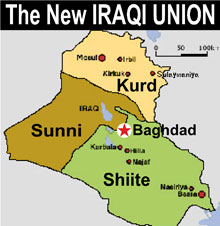
Indeed, the continued American presence in Iraq is a polarizing one, and it is polarizing Iraq in two important ways. As is often the case with foreign interventions, the introduction of the United States into Iraq has heightened tensions which previously were not very pronounced. The one thing about Iraq that our government and media "knew" prior to the invasion was that there was no such thing as Iraqis. From day one, we have approached the country as a sectarian jigsaw puzzle composed of Sunnis, Shiites, and Kurds. Why then would Iraqis act any differently when articulating their needs to Americans, or to each other? People speak to power in the discourses that are imposed upon them. Power leaders in Iraq looking for support employ these discourses and now Iraqi politics is largely dominated by them. The American presence has created tensions where they did not exist beforehand.

This is the mental map that most Americans have of Iraq
The second way in which the US occupation is polarizing Iraq is by dividing Iraqis into those who work with us and those who don't. The longer we stay in Iraq, the more complicated and difficult it will be for people to stay neutral in this conflict. Indeed, within both Sunni and Shiite communities, divisions have been created between those who cooperated with the occupation authorities and those who haven't.

If we stay in Iraq for four more years, there will certainly be quiet periods. The months immediately following the American military escalation of last year constitute one such period. But McCain is out of touch if he sincerely believes that this mission is ever going to be "accomplished." One way or another, we will leave. The question is how much long-term damage we will have inflicted upon the Iraqi people during the course of our occupation. In my opinion, the longer we stay there the worse they'll be in the end; more divided, and more embittered against one another not only with respect to sectarianism, but also with regard to the question of who gained power (and money) via the Americans and who didn't.

So yes, I can see that, once again, McCain appears to have little command over even the most basic facts regarding the only policy area he is actually supposed to know something about. But to me, the bigger problem is that McCain still sees the "setbacks" as the exceptions, when they are clearly the rule.


Thursday May 14, 1:04 am

Re my posting below on John Edwards, I do think that even if his endorsement is late, the timing is still good as it knocks Obama's (already largely ignored) WV defeat completely out of the news cycle.


Wednesday May 13, 9:19 pm

Is anyone else as underwhelmed as I am by John Edwards' endorsement of Barack Obama? I mean, it's a bit late, isn't it? I liked Edwards and even vaguely supported him back when he was in the race--I liked the fact that he alone among recent Democratic candidates was interested in talking about poor people--but he could have had much more of an impact if he'd made this endorsement back when the result of the contest was in doubt. Superdelegates are trickling in for Obama, and before long the race will be over.

The good news for Democrats is that they have picked up a third straight seat in a Republican district, winning a special election in Mississippi's first district. This is a good sign for Democrats, and will perhaps offset what appears to be obvious racist opposition to Obama in many instances. Indeed, some of this opposition also appears to be anti-Islamic, based upon the lie that "Barack Hussein Obama" is Muslim.


Thursday, May 8, 2:34 pm

CNN is reporting that Hillary is pronouncing herself as the candidate of white Democrats.

Clinton cited an Associated Press poll "that found how Senator Obama's support among working, hard-working Americans, white Americans, is weakening again, and how whites in both states who had not completed college were supporting me."

This is really shameless, but unsurprising coming from the Clintons. I know that people will make apologies for her use of this kind of rhetoric, but I think it's totally inappropriate.

By now, I think it's become obvious that the Clintons will stop at nothing to win this contest. The only way to end matters is to force them out: the superdelegates have to jump ship, publicly switch their support to Obama, and push him over the top mathematically. Howard Dean is kidding himself if he thinks Hillary is going to drop out in June, after the last primary is held. The Democratic convention will not end until August 28, folks. Are Democrats really prepared to wait that long to choose a nominee?

BTW: State officials in Michigan and Florida, seeking to increase their influence in the presidential contest, lost their votes at the Democratic convention by holding their primaries early. Yet, in the Democratic race, it is the states holding their primaries at the end of the season which have been receiving a disproportionately high amount of attention. Nice job, people!

12:43 pm

Apropos my posting last night on the list of superdelegates currently pledged to Hillary, I should have also included the list of currently unpledged superdelegates. I didn't see any of my elected officials on this list, but if any if yours are there I suggest you get in contact with them.

By the way, today marks the sixty-third anniversary of the German surrender. In Russia (and much of the rest of the former USSR), Victory Day (den' pobedy) is a major holiday and is celebrated on May 9th (time zone differences on the day of surrender account for the discrepancy). Here is a YouTube clip from last year's celebrations on Red Square in Moscow. C днем победы! Happy Victory Day!

Wednesday, May 7, 7:17 pm

Not surprisingly, the punditry is declaring it the end of the line for Hillary. Hillary, however, has settled into "Bunker Hill" mode, insisting that she will keep at it until the convention. Part of this is probably bluster, and much of it depends on whether or not she will manage to seat delegates from Michigan and Florida. However, she has already raised the specter of a credentials fight on the floor of the Democratic convention.

She said she would seek to have the Democratic Party's rules and bylaws committee this month reinstate the outlawed Florida and Michigan delegations that support her -- and "if people are not satisfied with that, they go to the credentials committee" at the convention, she threatened.

In any case, the convention isn't until August. This thing needs to be resolved before then.

Here is a list of superdelegates publicly pledged to Clinton or Obama, written in alphabetical order by state. Obama needs roughly 200 more delegates to clinch the nomination, assuming the party does not change its mind about not seating the (in my opinion, illegitimate) Michigan and Florida delegations. What would most easily push Barack over the top, however, would be for Clinton's superdelegate support to erode. She currently has (estimates vary), approximately 270 superdelegates. If half of this number switched to Obama, as former Senator George McGovern recently has (unfortunately he's not a superdelegate), then the nomination fight could end quickly and easily. I have already written to my Michigan superdelegates (Granholm, Stabenow and Dingell, the three appearing on my election ballots), asking them to publicly throw their support behind Obama. It's probably futile, but then again these are politicians and I'm sure they see the writing on the wall. Although I'm sure there are a number of Truthers out there, I wouldn't be surprised if at least some superdelegates wouldn't mind having a good excuse to hide behind in ditching Hillary. Give them a reason: write your elected superdelegates today!


Wednesday, May 7, 2:07 am

Barack Obama

Put a fork in this race already—it’s done.

Okay. Enough already. I am now officially fed up with Hillary Clinton---and I don't think I'm the only one. The media are growing tired of picking on Obama. The Reverend Wright business has run its course, and now that Barack has won NC I expect that we will start to see a slew of stories about how Obama is getting his mojo back, how the superdelegates are moving towards him in greater numbers, etc. The Washington Post is already running a late-night story on how the mayor of Gary, an Obama supporter,had predicted a "shocker," i.e. an Obama victory.

So now, any Obama victory in Indiana, no matter how small (even a moral victory through a close defeat?) is interpreted as a "shocker," a surprise win--even though Indiana was considered up for grabs not too long ago. The media have become bored with the current narrative, and now I think the stories will be mostly about the new "comeback kid." The end is near. Hillary is in the bunker. The only question that remains is how far she’ll take this. To the 'bitter' end, I imagine.

Speaking of the campaign, I liked Juan Cole's Monday posting on Hillary's "obliterate" comments regarding Iran. While I think Hillary, as the nominee, would offer Democrats a real alternative to Republicans with regard to domestic issues like health care, her perspective on the place of the United States in the world does not strike me as measurably different from that of the Republicans. In any case, threatening to 'obliterate' an entire country is really an appalling case of demagoguery and should have no place in mainstream political discourse.


Back to blog